The Pretty Parasites Tarot guide
Six of Cups
Copepod Boat
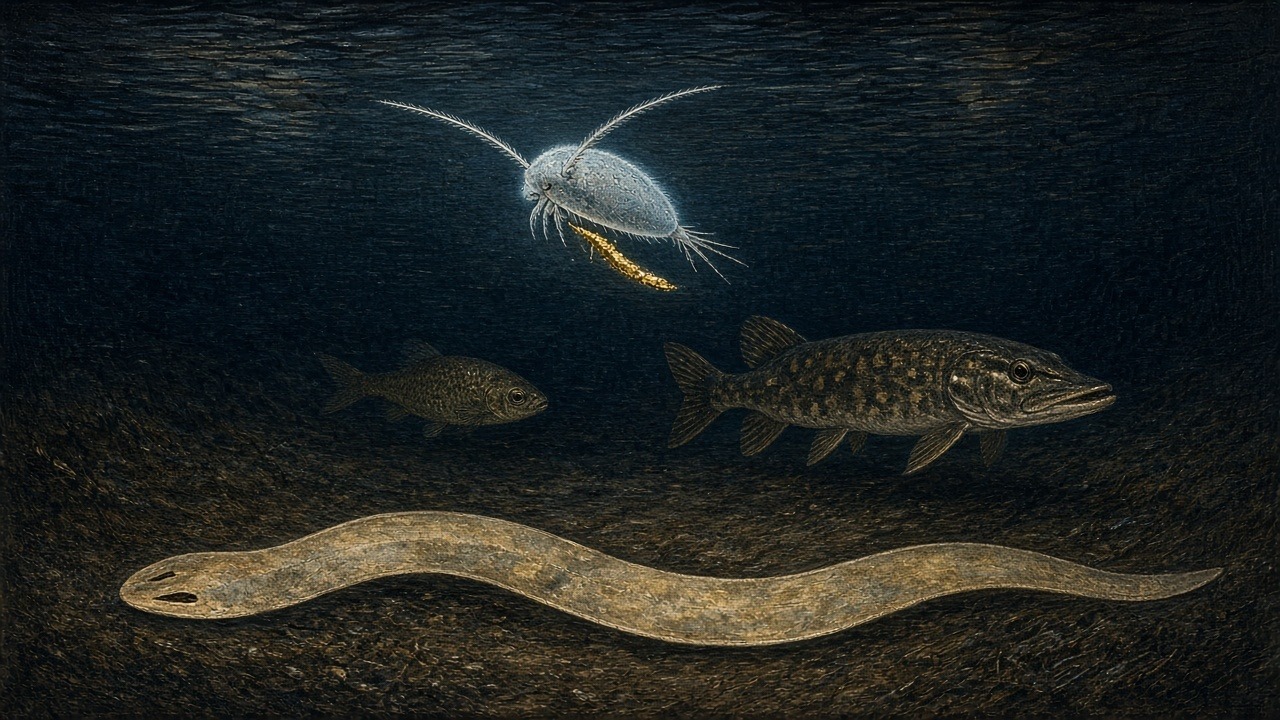
Dibothriocephalus latus (formerly Diphyllobothrium latum), the broad fish tapeworm
The Six of Cups is the sweetest card in the deck, and so it is the one to watch. A child hands a smaller child a cup full of flowers in a quiet courtyard. Readers call it nostalgia, innocence, childhood, gifts from the past, the return of something you thought was over. All true. It is also the card of things that come back to you from very far away, having changed several times on the road.
Meet the broad fish tapeworm, a traveler through three waters. It begins as an egg in a lake, which hatches into a larva so small and so briefly alive that it has only hours to be eaten by a copepod, a crustacean the size of a comma. Inside the copepod it becomes something new. A little fish eats the copepod, and the larva moves into the fish's flesh. A bigger fish, a pike or a perch, eats the little fish and inherits the passenger. Then someone on the shore cooks that fish lightly, or not at all, because that is how their grandmother made it, and the lake arrives, at last, inside a person. There, holding on with two grooves on its head, it grows into one of the largest animals that lives in humans: commonly several meters long, sometimes more than ten, made of thousands of segments, releasing up to a million eggs a day back toward the water. It asks surprisingly little in return. Most people never notice it. Now and then it takes enough of their vitamin B12 to make them anemic.
The history has the flavor of a family recipe too. In 1747 a Finnish physician, H. D. Spöring, noticed that people living beside lakes and rivers full of fish had more tapeworms. In 1881 the parasitologist Max Braun proved the fish stage by feeding larvae from pike to three medical students, who had volunteered, and then finding the worm's eggs in their stool. It took until 1917 for two other researchers to find the copepod at the very start of the chain. The worm's story was assembled the way memory is, backward, from the dinner table to the lake.
So this is what the Six asks. When something from the past returns to you, a person, a place, a taste, a way you used to be, what did it pass through to get here? Nostalgia is a boat with several passengers. The opportunity is real: the old dish, the old friend, the thing you loved at nine really can feed you, and most of what rides along is harmless. The risk is taking it raw, swallowing the past whole without asking what it has picked up on the way, and then feeding it for years without knowing.
Scene: a clear glass cup holding a lake; inside it, one copepod drawn like a small bright boat, a silver fish beneath, and a long ribbon of pale segments trailing through the water toward the rim; flowers floating on the surface, as in the traditional card.
Prompt: Write down a taste from your childhood. Trace it backward through every hand and place it passed through before it reached you, as far as you can go. What came along for the ride?