The Pretty Parasites Tarot guide
XII · The Hanged Man
Berry Hung in the Canopy
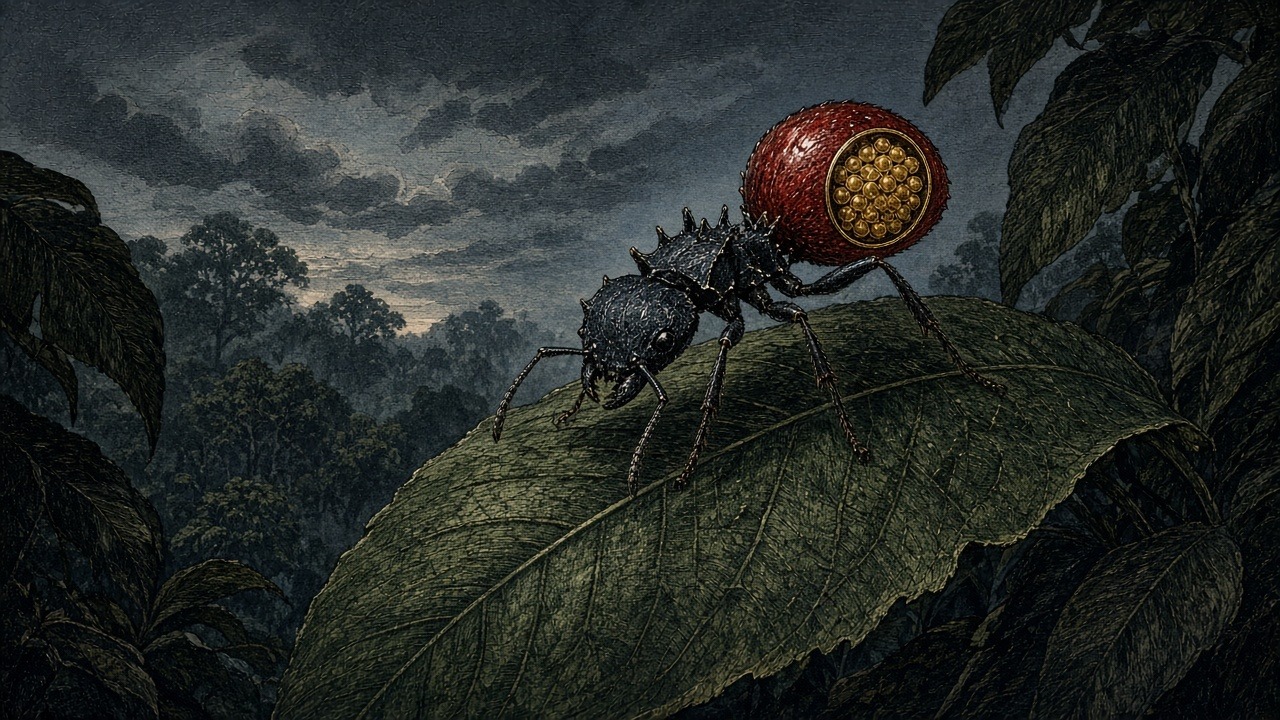
Myrmeconema neotropicum, a nematode, in the canopy ant Cephalotes atratus
Strengths: confidence, faith, introspection, receptivity, change, stillness, patience
Risks: isolation, inactivity, liminality, victimization, passivity, lethargy, helplessness
The Hanged Man is the Fool in the middle of his journey. He's been through a lot and must now slow down and contemplate where he'll go from here. Should he become like the Hermit and retire from society to contemplate the natural world? Should he become like the High Priestess and devote himself to the vast knowledge produced by those before him? Perhaps, like the Empress, he should devote himself to making as many babies as possible? Whatever he chooses, now is the time to stop and meditate on how far you've come and where you want to go from here.
Motto: Hang in there.
The Hanged Man hangs upside down from a living tree by one foot, the other leg crossed behind it to make a figure four, hands behind his back, a halo around his head. He doesn't look punished. He looks like someone who has just understood something. Unlike the usual hanging, this one is voluntary. Mythology is full of heroes hanged for dangerous ideas, and of figures who sacrifice themselves so that their ideas can outlive them.
The oldest version is Odin's. In the Norse poem Hávamál he hangs for nine nights on the windswept world tree, wounded with his own spear, given, as he says, "myself to myself." At the end of it he looks down and takes up the runes. Wisdom, bought with a hanging.
High in the rainforest canopy of Central and South America lives a big black ant, Cephalotes atratus. Its colonies feed their larvae on bird droppings, and that's how they swallow the eggs of a tiny nematode, Myrmeconema neotropicum. The worm grows in the ant's abdomen, and as its eggs mature, the abdomen turns from black to a glossy, translucent red. The infected ant slows down and walks about holding its red rear end up in the air, and the joint at its waist weakens. To a bird it looks exactly like a ripe berry hanging from the tree, and birds, the researchers think, pick it. The eggs pass through the bird, land on the leaves below, and are carried home by ants as food. It was the first parasite anyone had found that disguises its host as fruit.
That's the riddle. Odin hung on the tree to win its fruit, which was wisdom. The ant hangs itself on the tree as fruit. In Eden the fruit of the knowledge of good and evil hung from a tree too, and whoever ate it learned something terrible. In the canopy the fruit is an ant, the knowledge is a worm, and the bird that eats it learns nothing at all.
The 2022 draft gives this card to David Hume, who wrote that reason "is, and ought only to be the slave of the passions." The berry ant has reason of a sort, and passions it didn't choose, and every step it takes along the branch with its red abdomen raised presumably feels like its own idea. Sartre went further. In Being and Nothingness he insisted that even a prisoner is free, because he chooses what his prison means to him. Franky wanted the Hanged Man to stand for the freest thing a mind can do, which is think. The ant stands for the question underneath: how would you know which of your thoughts are yours?
If the Wheel of Fortune teaches that life is ruled by laws we can't control, the Hanged Man shows that, in spite of time and entropy, we make choices, and those choices decide which universe we end up in. We are as helpless as babies before time, but once we give up wanting to control what we can't, we're ready to think about our journey and its end, which we meet directly in the next card.
So when the Hanged Man appears, stop. Hang upside down for a while and look at your life from the wrong end. Ask which of your choices were really yours. Then check whether anything about you has started to look delicious to birds.