The Pretty Parasites Tarot guide
XIII · Death
Stroma as Dark Blossom
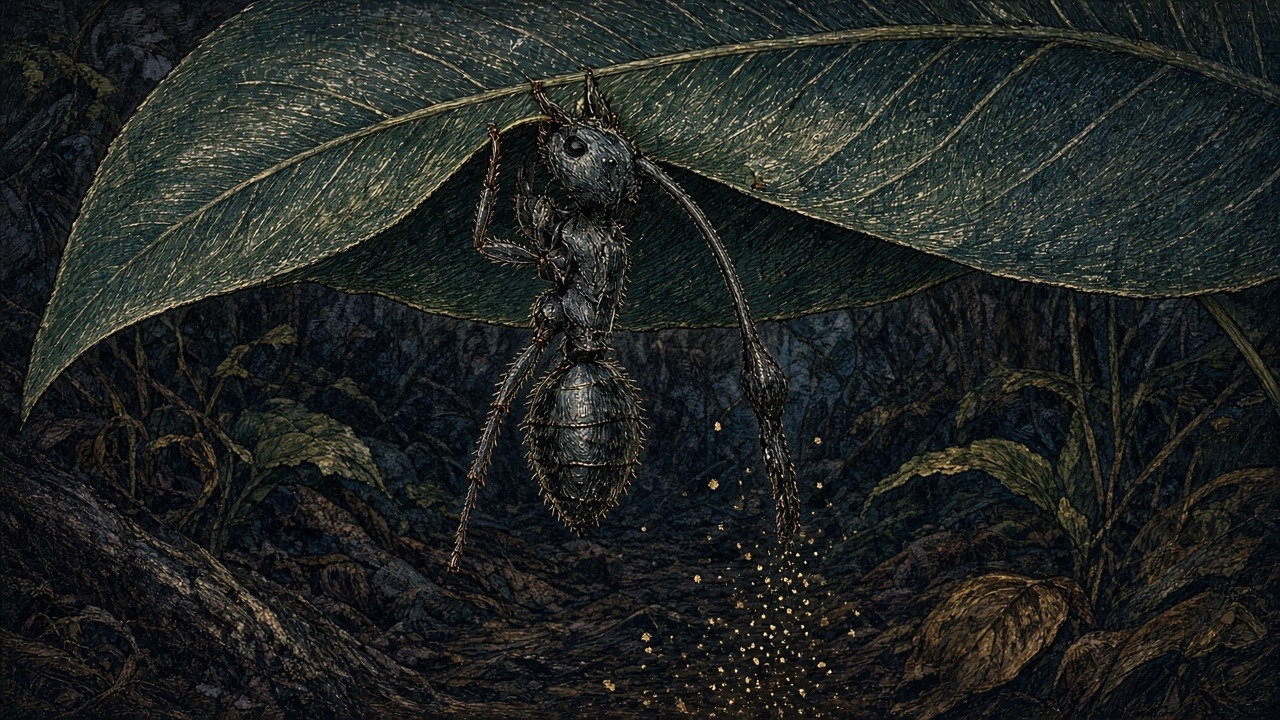
Ophiocordyceps unilateralis, the fungus of the carpenter ants' death grip
Strengths: closure, truth, honesty, clarity, illumination, lucidity, renaissance
Risks: loss, ending, rupture, bereavement, desertion, denial, betrayal
Death is the end. With this card you are invited to consider the end of your fears and your dears. Death is often represented by darkness, but Death's light is perhaps the most illuminating of all, showing only what is most important. The trivialities fall away. How do your fears compare with Death? You will die someday. Whatever you want to overcome, you must overcome before you die. This truth is as evident as cogito ergo sum. Focus on what's important and let distraction fall away. Consider how you would act if you had only four years to live, two years, one year, six months, three months, three weeks, three days. How would you act differently? What do you really care about? Carpe that diem before it's too late.
Motto: *Carpe diem.*
In the Rider-Waite deck, Death is a skeleton in black armor on a white horse. A king lies under the hooves, a bishop pleads, a child looks up without fear, and between two towers in the distance the sun is rising, or setting, which is the whole point. Death's black banner carries a single white rose. Keep your eye on the rose.
In the rainforest, a carpenter ant infected with Ophiocordyceps unilateralis leaves the trail where its sisters walk and climbs a plant. It stops on the underside of a leaf about twenty-five centimeters above the ground, where the air is just humid enough for a fungus, and at about solar noon it bites down hard on a vein. The muscles of its jaws waste away, so it can't let go, and it dies there, holding on. The fungus has threaded through its whole body, wrapping the muscles it needed and leaving the brain alone. Over the following days a dark stalk grows out from the back of the ant's head, a blossom on a corpse, and rains spores onto the ground below, where other ants walk.
Here is the riddle, and the motto gives it away. Carpe diem means "seize the day." The ant seizes it, at noon, with its jaws, and never lets go. The banner's rose is the stalk. The sun between the towers is the noon of the bite. And the fungus that leaves the brain alone is either the one mercy in this story or the worst detail in the book. The ant is, as far as anyone can tell, all there for its last hour.
None of this is new. Leaves from the Messel pit in Germany, forty-eight million years old, carry the same rows of bite scars along their veins. The dead ants have been holding on since long before there were apes to notice.
Of all the cards in the Tarot, Death is the only one that needs no explanation, and yet it's the hardest to apply to your own life. It doesn't have to be bad news. Death can mean the end of unpleasant people, pain, and circumstances. Failed marriages, failed states, and failed civilizations sometimes have to die to make way for something new, and a new paradigm replaces the old one only after the old one's funeral. Besides, death is necessary for life on both the supply and demand side. If you didn't eat, you'd die, and the things you eat would have preferred to go on living. To be against death, you'd have to be against life, a position argued by Arthur Schopenhauer, who played his flute every day, mostly Rossini, and died quietly on his sofa after breakfast at seventy-two, and by Philipp Mainländer, who published one book of philosophy, decided his life was no longer useful to humanity, and hanged himself at thirty-four.
The Hanged Man talks to Death about every subject in every language, and the conversation always ends the same way: "I guess it's Time." Does a universe that needs death make the pessimists right? Is it the work of some malevolent demiurge, as the Manichaeans taught? Augustine, who was a Manichaean for nine years before he became a saint, spent much of his later life arguing that evil has no substance of its own and is only the absence of good. If good is life and evil is death, then death, too, is nothing at all: when we die we don't gain a new property called death, we just stop having the properties of life. The friends of Death have an answer to that. Death, they say, is what makes your metabolism possible in the first place. Take E. coli, one of the trillions of bacteria living in the body you call your own. Under ideal conditions it doubles every twenty minutes. As the ecologist Eric Pianka points out, if nothing stopped it, after thirty-six hours a foot-deep layer of bacteria would cover the whole Earth, land and sea, and an hour later it would be eight feet deep. Something always stops it. That something is Death, and you have it to thank for the fact that you aren't standing in eight feet of bacteria.
Then there's murder, the killing of something that doesn't want to die. Humans are very good at it, which is one reason there are so many humans, and we teach it early. Jane Legge's poem "Learning to Be a Dutiful Carnivore," which Cora Diamond quotes in her essay "Eating Meat and Eating People," catches the lesson in a couplet: "Grow up into double-think / Kiss the hamster; skin the mink." Our ancestors killed off the really dangerous animals, so we wouldn't have to: mammoths, ground sloths, moas, and whole herds of big grazers went the way of the dodo. Human life is the most important thing in the universe. It says so in Article 3 of the Universal Declaration of Human Rights: "Everyone has the right to life, liberty and security of person." The Empress would like to add "and reproduction." We are just as good at metaphysical murder, the killing of gods like Tiamat, Yama, Osiris, Yan Luo Wang, Xipe Totec, and Hades and his little dog Cerberus too. "We didn't kill them," you might object. "We just stopped believing in them." Technically true, though we certainly killed a great many people who believed in the wrong god, or the right god the wrong way. Deicide and homicide are among our most impressive accomplishments, right up there with Boolean logic, hyperbolic geometry, and Bayesian reasoning.
So when Death turns up, ask Franky's question: which of your revolutions are coming to a close, and which should you drop? There are no perpetual-motion machines, and your resources are limited. Then ask the ant's question, which is harder: what are you holding on to, and is it you who's holding?