The Pretty Parasites Tarot guide
XIV · Temperance
The Rattle That Opens the Meadow
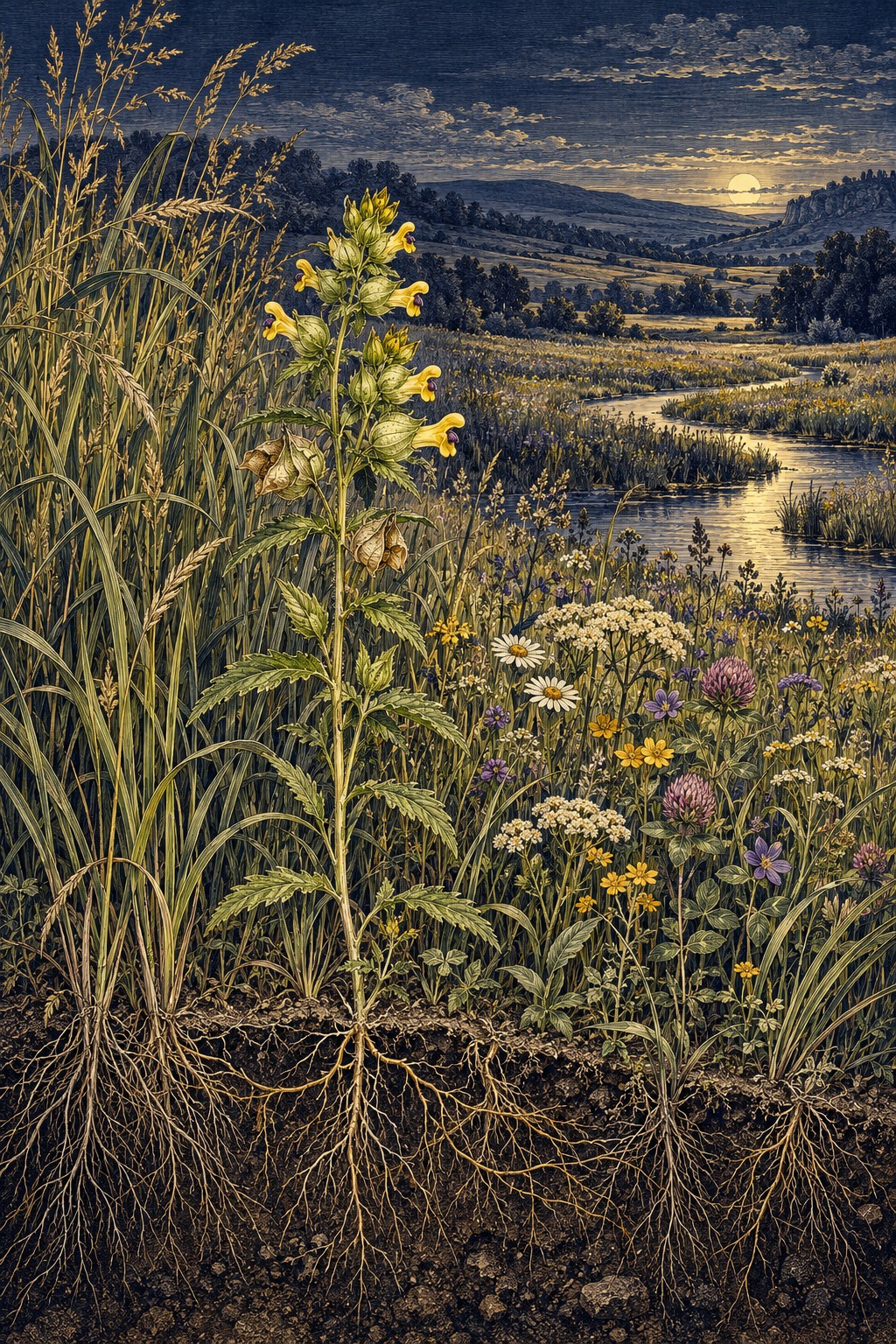
Rhinanthus minor, yellow rattle, a half-parasitic meadow plant
Strengths: opportunity, privilege, negotiation, conciliation, union, balance, meticulousness, deliberateness, equality, moderation
Risks: compromise, perfectionism, fastidiousness, hesitancy, diffidence, sacrifice
Temperance is equilibrium. It is the ability to balance not only our actions but the virtues of action themselves. Of the four cardinal virtues it is perhaps the hardest to achieve, since it requires awareness of as many sides of a situation as possible in order to act harmoniously in the world. When this card appears, look carefully at the other cards in your spread. This is the time to take a bird's-eye view of your situation, perhaps even to invert the chronology and consider how the future has affected the past. Whereas the Hanged Man stops all action to reflect, Temperance asks you to weigh as many consequences as possible in the middle of the fray. It is time to bring all the cardinal virtues together.
Motto: Nothing in excess.
On the Temperance card an angel stands with one foot on land and one in a pool, pouring water from one cup into another. Nothing spills. It's the calmest card in the deck, and it comes right after Death, which is either a reward or a recovery.
We all know water is essential for life. It's the medium that lets countless reactions happen inside a single coherent system, and the Earth's near-miraculous balance depends on it. What could be more valuable than our own precious bodily fluids? Temperance is the water of human action, present or missing in everything we do, and mostly unnoticed. People will praise your strength, your prudence, and your sense of justice, but nobody throws a party for your temperance.
Yellow rattle is a pretty meadow flower with a yellow, snouted bloom (Rhinanthus means "nose flower") and an unpretty habit. It makes its own sugar from sunlight like any green plant, but its roots reach out to the roots of the grasses around it, tap into them, and drink their water and nutrients. It is half a plant and half a thief, a parasite in moderation. And it takes most from the strongest. Sown into a hayfield, it cut the grass's growth by about a fifth to nearly half in three of four trials, and in every study that counted, the number of wildflower species went up. In one Oxfordshire experiment, plots that had held one or two sown wildflower species held almost six once the rattle moved in. Farmers called it a pest because it shrank their hay. Conservationists call it the meadow maker.
So here is the riddle of the card. The angel pours water from one cup to the other, and you are meant to wonder where it comes from. Now you know: it comes from the grass. Temperance, in this deck, is not abstinence. Abstinence is regularly taken too far, to the point of harm, and then it becomes the opposite of temperance. Temperance is a small, steady theft from whatever has too much, so that everything else can grow. It's Aristotle's golden mean with roots.
Prudence asks us to know our own motives, Temperance to foresee the outcomes, Fortitude to persevere, and Justice to treat others fairly. Turn down a gift you know is bad for you, and you may offend the giver. So do you accept it? Do you pretend to like it? Do you accept it without feeling either way? It's a simple example, but the decision tree grows exponentially, since every action has at least two reactions. We live in time, and we can't hang in the Hanged Man's pose forever. Temperance is acting with prudence, fortitude, and justice, just as prudence is acting with temperance, fortitude, and justice. The virtues turn in on themselves, like water poured between two cups.
Aleister Crowley renamed this card Art in his Thoth deck and made the angel an alchemist, mixing fire and water in a cauldron. The meadow does the same thing more quietly. Every summer the rattle's seeds dry in their papery pods and rattle when the wind blows, which is how it got its name. It's an annual, so it has to start over from seed every year. Moderation, it turns out, has to be renewed.
When Temperance appears, ask what in your life has grown too tall and is shading everything else out. Then ask whether you're the grass or the rattle. And if you're the grass, take it gracefully. The meadow is better for it.