The Pretty Parasites Tarot guide
XVI · The Tower
The Canker That Felled the Vault
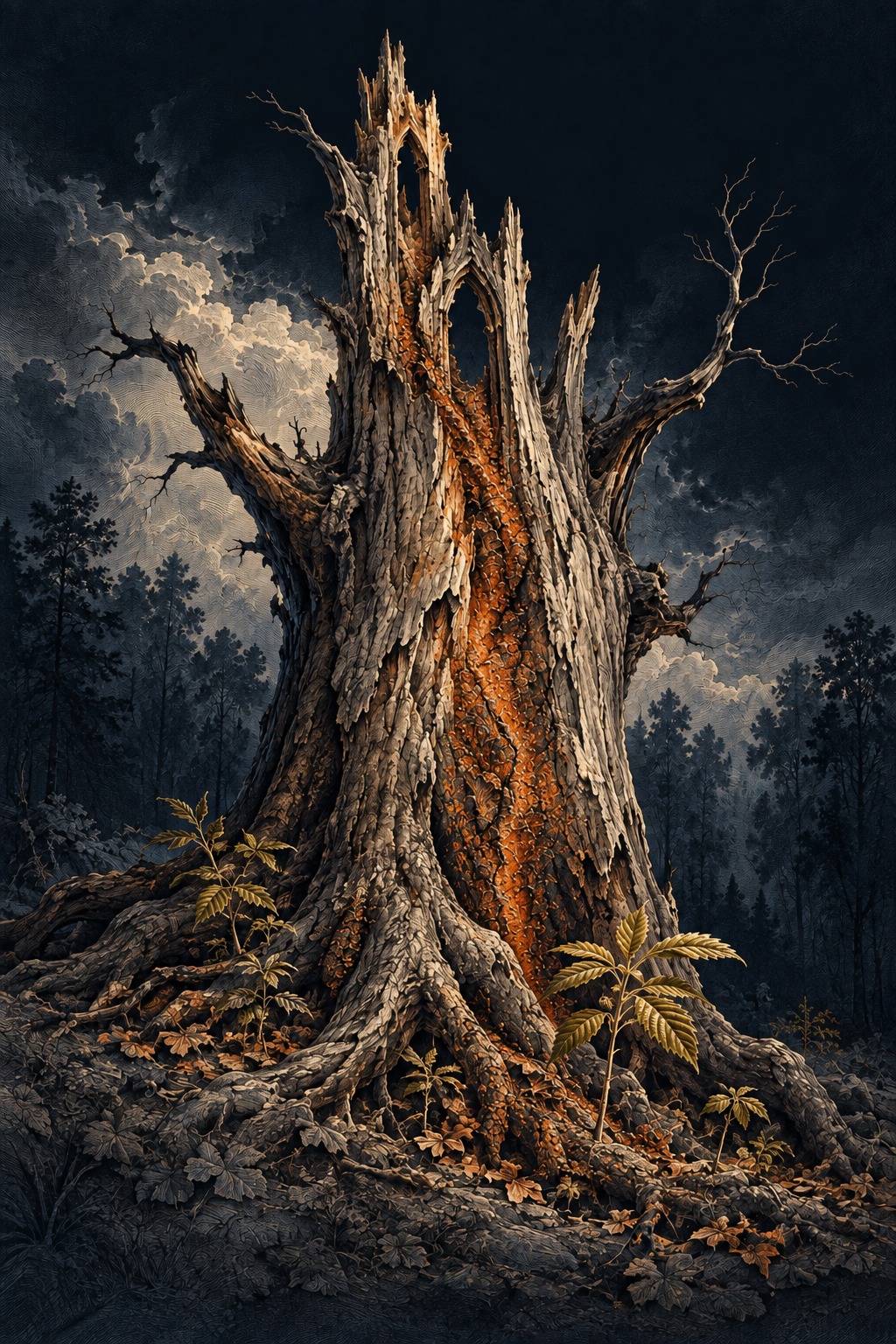
Cryphonectria parasitica, the chestnut blight fungus
Strengths: birth, deliverance, truth, liberation, purification
Risks: rupture, struggle, destabilization, shock, upheaval, crisis, contradiction, trauma, collapse, chaos
The Tower is failure. Often the things that fail are the important things we're least aware of. Humans have a habit of taking things for granted. Your heart, for instance, keeps everything else moving forward. Your journey depends on the blood circulating in your veins, but how much of your life do you live with that in mind? What do you do that endangers your heart? Stop doing it if you want to live. Now take the heart as a stand-in for the rest of your life. What are you most afraid of losing, and what might you do to prevent that loss? Or are there things you consider crucial that could be abandoned? The Tower makes you take stock of your greatest failures, past, present, and future. Consider which battles are best lost and which require total victory. This card also makes you consider the failures of your opponents. If you were God, what would you defeat utterly, and why? Are your reasons just? Are they virtuous? By considering your enemies you can learn a great deal about yourself. Could losing to certain opponents be a good thing? Consider your failures and your enemies.
Motto: Out with the old, in with the new.
On the Tower card, lightning strikes a stone tower, the crown on top blows off, fire pours from the windows, and two people fall headfirst into the dark. It's the most violent card in the deck, and the oldest reading of it is Babel: the tower humans built to reach heaven, and the God who knocked it down.
In 1904, a forester named Hermann Merkel noticed that the American chestnuts at the Bronx Zoo were dying. The cause was a fungus that had come over from Asia, Cryphonectria parasitica. It gets in through a crack in the bark, spreads under it as an orange canker, and girdles the trunk, and everything above the canker dies. Over the next half century it killed somewhere between three and a half and four billion trees. The American chestnut, which had roofed the eastern forests like the vault of a cathedral, was gone from the canopy within a lifetime.
Here's the riddle. Look again at the card. The lightning comes from outside, but the tower falls from the top, and the crown goes first. The chestnut falls the same way. The blight kills the crown and leaves the roots alone, and the roots keep sending up new shoots. Millions of American chestnuts are still alive today as sprouts in the understory. They grow for a few years, reach the height where the bark starts to crack, and are struck again. The tower keeps rebuilding itself to exactly the height of its fall.
Then the revolution ate its children. In Europe, the blight itself caught a virus, CHV1, which weakens the fungus enough that infected trees can heal over their cankers, and foresters there now spread the virus on purpose. Robespierre is on Franky's list for this card, and he would have understood: every blight eventually meets its own.
The Tower is about falls, and in religion the falls come with gifts. The first is in Genesis, when humans eat from the tree of knowledge. The second is Babel, which gave us language as it is now. Both knowledge and language are tied to a fall, and in both cases the fall is God's punishment for competing with him. Scattering humanity into many languages was meant to divide people into tribes. It also multiplied the human imagination. The tribes fought, and out of the wars came medicine, computing, and physics, sooner than they would have come otherwise. The internet started as a military network, and the cryptography it runs on was born in war.
We all have things that would be improved by failing. Giving up on an unrequited love will leave you better off in the long run. Winning a war is sometimes a heavier burden than losing it. After the Second World War, Germany and Japan lost, and their rigid political systems were torn down and rebuilt. The Soviet Union and China won and kept theirs. Fast-forward fifty years, to 1995, and ask yourself which country you'd rather have lived in. For many children the best thing that can happen is the divorce of their mean parents. The failure of a bad project is the only way to start a better one.
Life itself works this way. In the theory of punctuated equilibrium, new forms evolve in bursts after sudden change, and every great extinction has been followed by an explosion of new forms. About two and a half billion years ago, the first oxygen released by microbes was a poison that wiped out much of the life that came before it. Now we can't live without it. In science the fall is the paradigm shift, from Aristotle to Galileo, and from Newton to Einstein and Schrödinger.
When the Tower turns up, don't assume this is the only failure on your road. Look at your failures in general. Which ones turned out in your favor? Where are the cracks in your bark? And if something in your life has already fallen, check the roots. They may still be sending up shoots, and it's worth asking whether you want them to.