The Pretty Parasites Tarot guide
XVII · The Star
Scarlet Brush of Borrowed Light
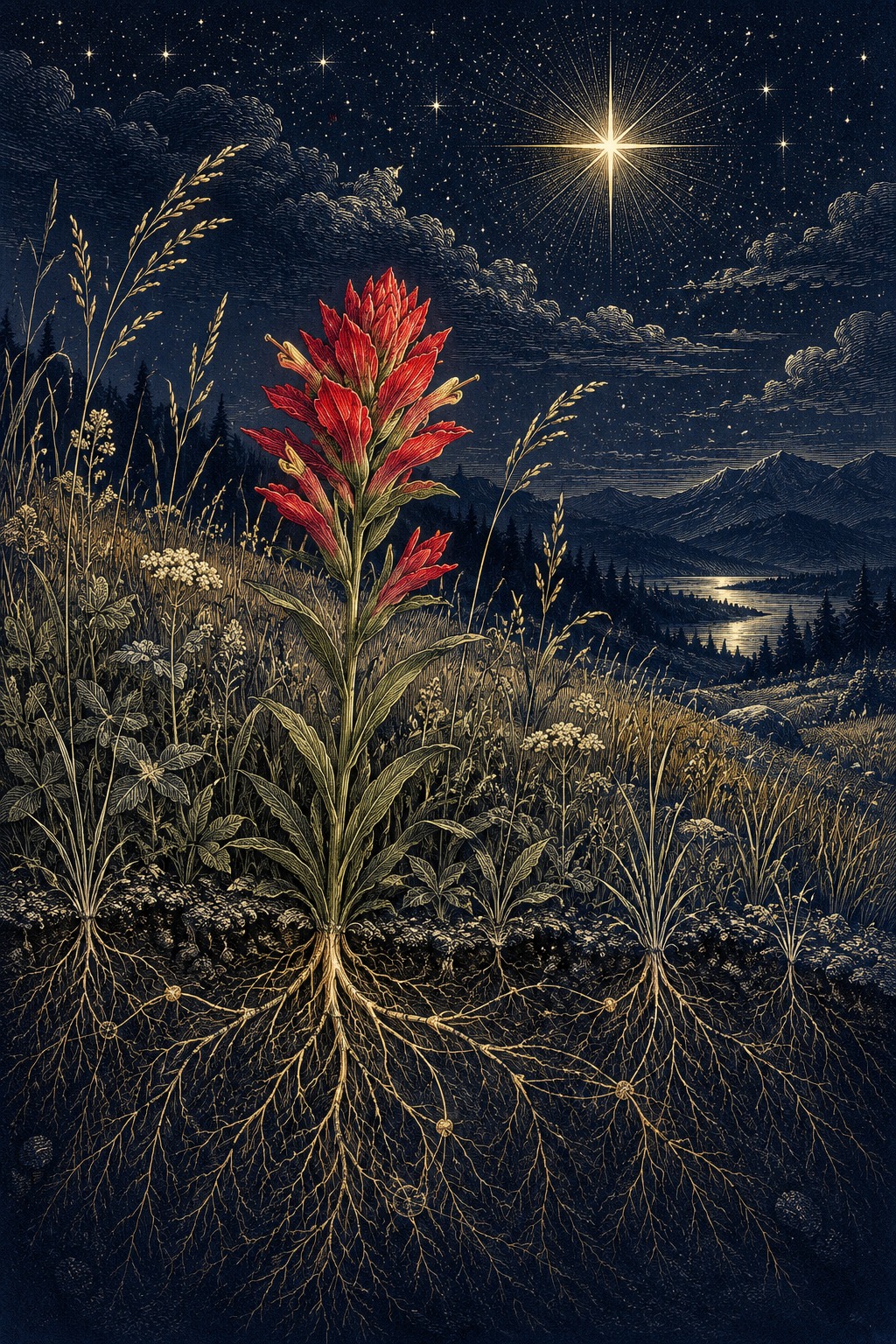
Castilleja coccinea, scarlet Indian paintbrush, a half-parasitic wildflower
Strengths: abundance, creation, success, luck, truth, generosity, selfless action
Risks: selflessness, conflagration, annihilation, apocalypse, war
The Star is free energy. So is a supernova, which is a star that gets really excited: the energy is free to do whatever it wants. We can react to it, we can harness it, but in the end it does what it wants and we can't control it. Of all the cards in the deck, the Star is Death's double. Death takes life away; the Star gives it. Neither can be stopped, no matter how advanced our technology. So what parts of your life give you the most for free? Exercise? Being outdoors? What do you enjoy that costs as little as possible? Focus on that in the context of your reading.
Motto: Everything is free.
In most decks this is the luckiest card, described with words like "lovely," "fortunate," and "divine," and some guides insist it is never negative. On the Rider-Waite card a naked woman kneels by a pool under eight stars, pouring water from two jugs, one into the pool and one onto the land, while a bird watches from a tree. She gives and gives and asks nothing back. When you draw it, consider the sources of free energy in your life. So much of our good fortune goes unnoticed. We didn't create life, and we don't maintain it. The sun does. Even the last day of your life will have light around it. You may not have earned your good fortune and you may not deserve it, but the good thing about the Star is that it's all for free.
The scarlet paintbrush is the most generous-looking plant in the meadow. Its tufts of red look as if someone dipped a brush in paint and forgot to stop, and the hummingbirds come for it. But the red is mostly not flower at all. It's bracts, leaves that have dressed up as petals. And the plant, though green, sends its roots into the roots of its neighbors and draws on them. What it gives away, it got from somebody else.
Here's the riddle in the title. The Star's light is borrowed, and so is all starlight: what you see at night left those stars long ago. Some of the light you see on a clear night is older than writing. The Star is Death's double because every star is also a little ghost.
Paintbrushes are shaped by whoever they borrow from. In one study of a related species, paintbrush growing on an alkaloid-rich lupine made three times as many seeds as paintbrush growing on grass and drew more pollinators. Paintbrush can even pick up the chemical signals its host plant sends out when it's being eaten. The generosity is real, and so is the bill. The Star's hidden lesson is the one Franky wrote in 2022: wherever there is generosity, there is someone ready to take advantage of it. Her light is wanted by many things that use her gifts for mean ends. Each of us has some of that light, and each of us can be used. That doesn't mean holding back what you have to offer. It means knowing where it comes from, and whom it feeds.
Our own star keeps it all going. There are something like two hundred billion trillion stars in the universe, and we take ours for granted. Stars fuse hydrogen into heavier atoms, and earlier generations of stars forged the carbon and oxygen we're made of. Ancient civilizations thanked their star for every harvest. Ours barely notices it, until it reminds us. In 1859 the Carrington Event, the biggest solar storm on record, set telegraph lines sparking and lit up the skies with auroras far from the poles. That was three years after the Crimean War ended. In some branch of the multiverse, they happened together.
The Night the Sky Caught Fire
The early Mormons are sometimes said to have believed God lived on a star. Mark Twain, who passed through Utah, said the local whiskey, Valley Tan, was "of Mormon invention and manufactured only in Utah. Tradition says it is made of (imported) fire and brimstone." The following conversation, between a Mormon sheriff, Mark Twain, and a Russian engineer touring the States on a government fellowship to study the telegraph, probably took place somewhere in the multiverse.
Having secured his room at Philander Butler's makeshift inn, Dmitry made his way to the little saloon beside the brewery. He'd seen many like it in California, but this was the first he'd visited in Utah Territory. He gave the bartender a silver dollar for the room and a bottle of light brown whiskey that smelled of spirit and cabbage, and he took a small table by the window. Three men at the bar were talking about the war. Few Americans this far west paid attention to it, and no one he'd met in Utah knew where Crimea was; the most common guess was an island in the Aegean. Dmitry's English was good, better, he felt, than most of the Westerners', since his English governess had taught him that cowboys spoke a mongrel dialect. The man at the center of the conversation had a broad white mustache and seemed dressed for an African safari. "I'll believe in anything, if you'll believe in everything," he said. "Am I getting you right?" His slow drawl made the others laugh.
"Would you like a shot?" Dmitry asked, offering the bottle. He'd learned the expression in Los Angeles and wondered whether it would work in the heart of Mormon country.
"I don't shoot," said the sheriff.
"The Word of Wisdom," said Twain. "God discourages the sullying of precious bodily fluids. I'll take a spill if you're offering, but I wouldn't shoot it." Dmitry filled his glass. "Much obliged," said Twain, and sipped, letting his mustache soak in the whiskey.
"Russia is protecting our Christian brothers in Palestine," said the sheriff, tipping his cup of cider toward the Russian. "All the British and French care about is trade. They'd forsake Christ for a dollar."
"Britain, France, and the Ottomans went to Crimea to destroy the Russian naval base at Sevastopol," said Twain after a long pause. "I don't think they were thinking of Palestine. My wife's cousin was there when they put up the Sebastopol Monument in Halifax."
"Yes," said Dmitry, surprised. "The one monument to that war in all America."
"Oh, it's not in America," said Twain. "Americans know two cents about that war. We stayed out of it entirely, and the few senators who wanted in were on the Russian side. Our commander in chief was too busy confounding the slavery question to bother with the world."
"Franklin Pierce is not our finest president," said the sheriff.
"But why?" said Dmitry. "Why would Europe choose the Ottomans over a Christian nation?"
"Simple," said Twain. "You people are getting too big for your britches."
Just then there was a crackling sound from the telegraph office next door, and the lamps seemed to flicker. The sheriff rose and went to the door, and the others followed. Outside, the three men saw something none of them had ever seen. The whole sky and every cloud were lit as if it were morning, red and green, and the crescent moon was almost invisible.
"What the hell is that?" said Twain.
"Free energy," said Dmitry, who had read the card.