The Pretty Parasites Tarot guide
VI · The Lovers
The Canoe of Pairing
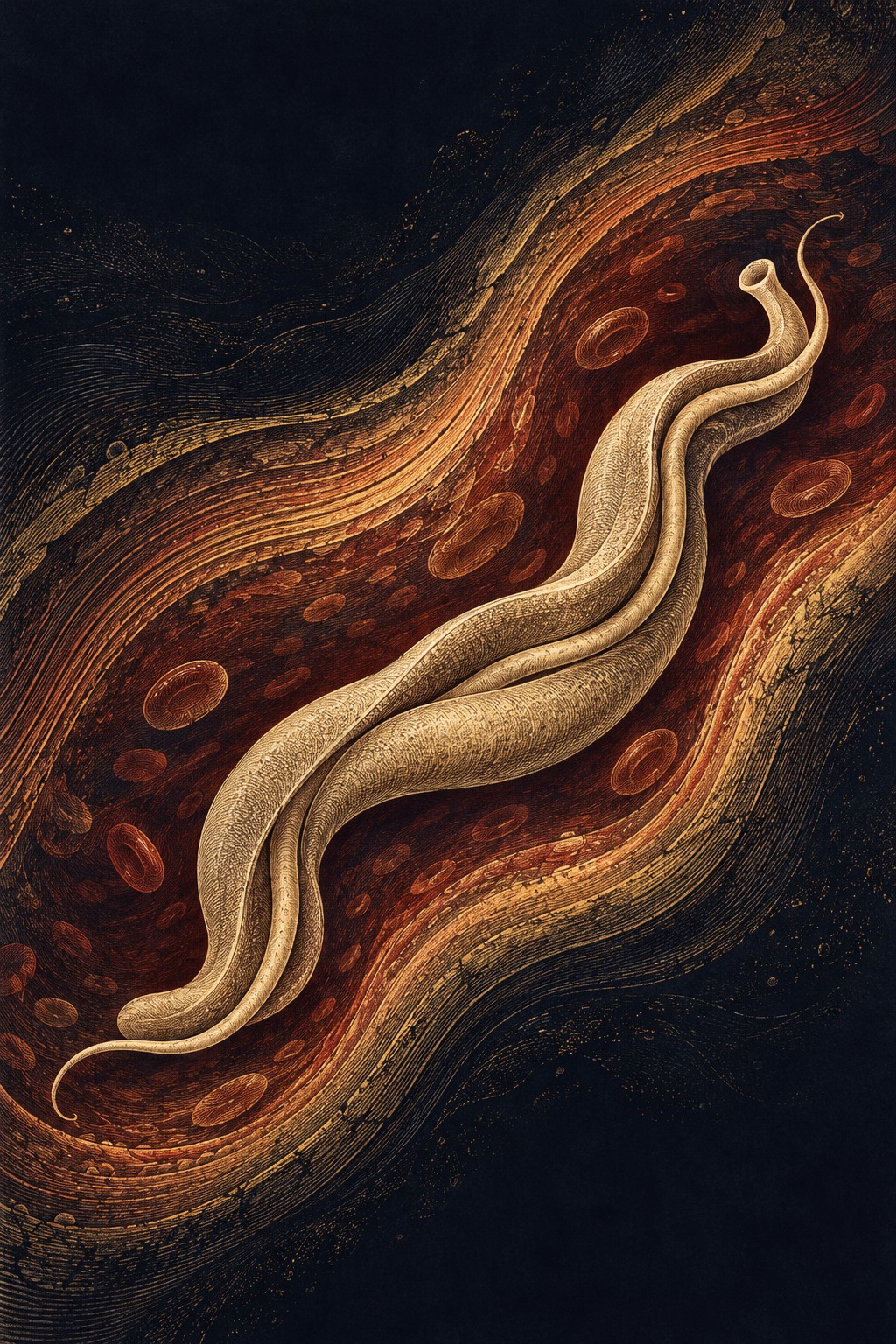
Schistosoma mansoni, a blood fluke
Strengths: affection, care, courtship, union, commitment, determination, friendship, passion, loyalty, romance
Risks: addiction, delusion, blindness, idolatry, ignorance, infatuation, codependency, frivolity, chaos, illusion, betrayal, mania, obsession, neurosis, zeal
The Lovers are eros—sexual love. Evolution has molded love as one of its most powerful drives. The desire to love and to be loved may be the strongest bond homo sapiens can muster. They will do everything to protect their union. From wizened statesmen (Anthony and Cleopatra) to frivolous teenagers (Juliet and Romeo), they are ready to sacrifice everything at the altar of love. Consider who around you is in love. Are you? Does someone love you? How will this affect everything else?
Motto: I defy you, stars.
The Lovers represent… well… love. There are, of course, many different kinds of love. There is philia—love between friends and family; pragma—enduring love; storge—familiar love; ludus—playful love; philautia—selflove; and agape—selfless love for humankind just to name a few. But for a card that has historically depicted a man and a woman (often nude) with an angel or angelic spirit hovering over them, it's safe to assume that the lovers in this case represent eros—romantic love. This is all I'll discuss here, but for those of you who think the Lovers card represents like the love between you, your grandma, and your mutual love of cribbage then more power to you, but let's be honest here—this card is about sex and all that it entails for meat machines whose prime directive is still "Be fruitful and multiply."
At this point, I considered including some quotes about how love is life (Gandhi) or strength (Abraham Lincoln) or beauty (Shakespeare) or God (choose your favorite religion), but instead I thought I'd share a quote by the 13th century Beguine mystic Hadewijch of Antwerp in which she uses the form of courtly love poetry, but here she is the knight and Love is the lady:
Hell is the seventh name
Of this Love wherein I suffer.
For there is nothing
Love does not engulf and damn.— Hadewijch of Antwerp, Stanzaic Poem 33 (excerpt), trans. Mother Columba Hart, Hadewijch: The Complete Works (Paulist Press, 1980)
As Sonja reasons in Woody Allen's Love and Death: To love is to suffer. To avoid suffering one must not love. But then one suffers from not loving. Therefore, to love is to suffer; not to love is to suffer; to suffer is to suffer. To be happy is to love. To be happy, then, is to suffer, but suffering makes one unhappy. Therefore, to be unhappy, one must love or love to suffer or suffer from too much happiness.
Imagine the first tragedy that comes to mind and love is the reason things go wrong or the reason someone is betrayed. From Shakespeare's Henry VI to the Tempest—love is what drives people to do rather unsavory things and more often than not leads to their untimely demise. For those of you who don't know who Margaret of Anjou is, check her out. Hailing from the love obsessed country of the Gauls, she appears in four Shakespeare plays and is a character driven by first being taken prisoner by Suffolk, who woos her for the king and for himself, then losing the love of her life, and then marrying a dolt whom she cannot love. The inability to love whom you're supposed to love being a salient drive to do rather unsavory things. She even took part in Love Day, a staged reconciliation in which old enemies walked hand in hand into St Paul's and were back at war within a year. Surprise, surprise. It's almost as if the very word sets people on edge and brings out their most atavistic instincts. And in Shakespeare's The Tempest, the sorcerer Prospero literally uses love as a weapon even though he's a nearly omnipotent wizard. The weaponization of love should make us wonder about what love really is. From the time humans stumbled out across the savannah to the kings of yore, love has played a central role in the species and its dynasty, I mean destiny. If human psychology were a Swiss Army knife, love would be the knife. Without love men would not only not compete for women (often murderously), but they wouldn't stick around to provide their beloved with the necessary resources to raise the product of their passionate union—essentially a helpless, premature fetus that not only can't even stand for upwards of a year, but can't obtain its own food for like four, eight, twelve years? I don't know. When are people old enough to fend for themselves? In some cases, I feel like the answer is something like two dozen generations of octopuses (highly intelligent creatures that seem to be fully independent their entire lives and who have no need for love, despite their ability to reason, play, and do many of the things humans tend to pride ourselves on). Anyway, although love is indispensable for homo sapiens, it's a veritable handicap for most other intelligent species.
The Lovers card is by far the most often tattooed by people who don't fully understand what it means in the Tarot and definitely don't understand what it means in the general scheme of evolutionary biology. So before you go off gracing your epidermis with this symbol of the consumerist arcane, or think you're somehow edgy because you tattoo the lovers as skeletons and think you're acknowledging the Lovers pair card in the Major Arcana—Death—let us consider the Lovers' actual pair card: the Devil.
The Lovers card usually depicts some sort of sexual pair: Kim Krans goes with the graceful eternal love of waterfowl—two geese flying majestically under a brilliant sun; Sam Guay references the biblical tree of knowledge by showing what looks like someone making out with an apple tree; or there's that edgy version of two skeletons kissing as in the Moon Readings deck (whomever Moon is). But here I'll just reference the 1909 Rider–Waite and the Tarot of Marseilles, which is the closest thing we have to the original deck which probably originated in Italy circa 1400. In both decks a man and a woman are portrayed with an angel above them like some puppet master either cajoling or directly controlling the pair. If we look at the Rider–Waite, the tree of knowledge is clearly portrayed by the female with a snake in that tree. The not so subtle imagery here doesn't need to be explained, but the fact that the actual devil is portrayed in the card is instructive, because in both the Marseilles and Rider-Waite, the only other card representing this triangle of man, woman, and angel is the Devil card. In the Rider-Waite, even the woman is again depicted with a piece of fruit. Now we might say, wait a minute, but the angel in the Lover card is good and the Devil is obviously bad, just because the two cards look the same doesn't mean they mean the same thing. Right? All sorts of things look like each other. It just happens to be that angels are involved in all the important things people do and so it would only make sense that an angel oversaw humanity's love and fall. But remember, there are actually two angels in the Lovers card. Lucifer is right there in the tree. Surely Lucifer doesn't need to be in that card. He already has his own card in the Devil card. But that's the rub folks, he is depicted in the Lovers card and he's literally intertwined with the tree that causes the fall of man—the original sin that makes God damn woman to the horror show of childbirth and man to his Sisyphean toil. Remember, the fall is not a good thing. To all the people, and I personally know two who've literally tattooed the Rider-Waite Lovers card on their thigh (don't think this is a coincidence), you've emblazoned yourself with one of the most recognizable depictions of the fall of our species. Presumably Adam loved Eve more than God, why else would he listen to her instead of God? I mean there had to be a lot of fruit to eat in the garden. When she presented him with the pomegranate or apple or whatever it was, he could have just picked up a pear or an orange, right? But he didn't and now we're all paying for their original sin committed in the name of love. With the angels (even the good ones) watching, not intervening just watching and you have to think what exactly were they thinking.
* * *
Most decks paint the Lovers as a garden wedding: two naked people, an angel overhead, a tree with a snake in it for anyone who needs reminding what gardens are for. Readers who know better will tell you the card was never really about romance. It is about choosing, about the values you bind yourself to when you bind yourself to someone. I'd put it more plainly. The Lovers is the card of what you agree to live inside.
Here is a marriage that happens in a vein. The male blood fluke is a small, pale, muscular worm with a long groove folded down his belly. The female is longer and thinner, and she lives in that groove, held along most of her length like a paddler in a canoe. The two of them lodge in the veins around a person's gut and stay there, paired, making eggs. It is the tenderest posture in the whole deck, and it takes place in your bloodstream. Biologists add one detail that the wedding painters never do: pairs can separate, and a worm can take a new partner. The female lays eggs only while she is held. Even here, fidelity is something that keeps getting chosen.
What makes them Lovers rather than a fling is time. In the early 1980s, doctors in Western Australia reviewed sixteen patients who had been diagnosed with schistosomiasis in a place where nobody catches it. Many were Polish refugees who had caught it in East African refugee camps, before they sailed for Australia in the early 1950s. Several had lived there more than thirty-one years, and the worms were still alive in them. The doctors could find no earlier record of a life that long. Thirty years later, a lab studying planarians, the flatworms famous for regrowing from a fragment, found that adult blood flukes carry similar stem cells, which keep rebuilding the worm's gut and muscle. The researchers were careful to say this probably helps explain the decades, not that it proves it. I like that caution. Nobody really knows why a marriage lasts either.
None of this is a love story for the host. In 2024 at least 253.7 million people needed treatment for blood flukes, and most of the harm comes from the eggs, which lodge in tissue and inflame it. The canoe floats on somebody else's river. That is the card's other face, and the one the garden paintings leave out: every union is also an ecology, and someone is paying for the water.
So when the Lovers comes up, the question isn't "Is this the one?" It is "What am I agreeing to live inside, and for how long?" The opportunity is the real thing: a bond that renews itself, cell by cell, long after the story says it should have worn out. The risk is the same thing seen from the vein wall, a long, comfortable arrangement that feeds on a body neither partner ever looks at.
Scene: two pale worms in a single curve, one cradled in the other's fold, drawn as a slender canoe gliding along a red-gold vessel; faint rings in the vessel wall like the growth rings of a tree, marking decades.
Prompt: Write about a bond in your life that has lasted longer than you expected. What keeps rebuilding it? Then write one paragraph from the point of view of whatever carries it, the thing the bond floats on.