The Pretty Parasites Tarot guide
XI · Fortitude
The Silk Bodyguard
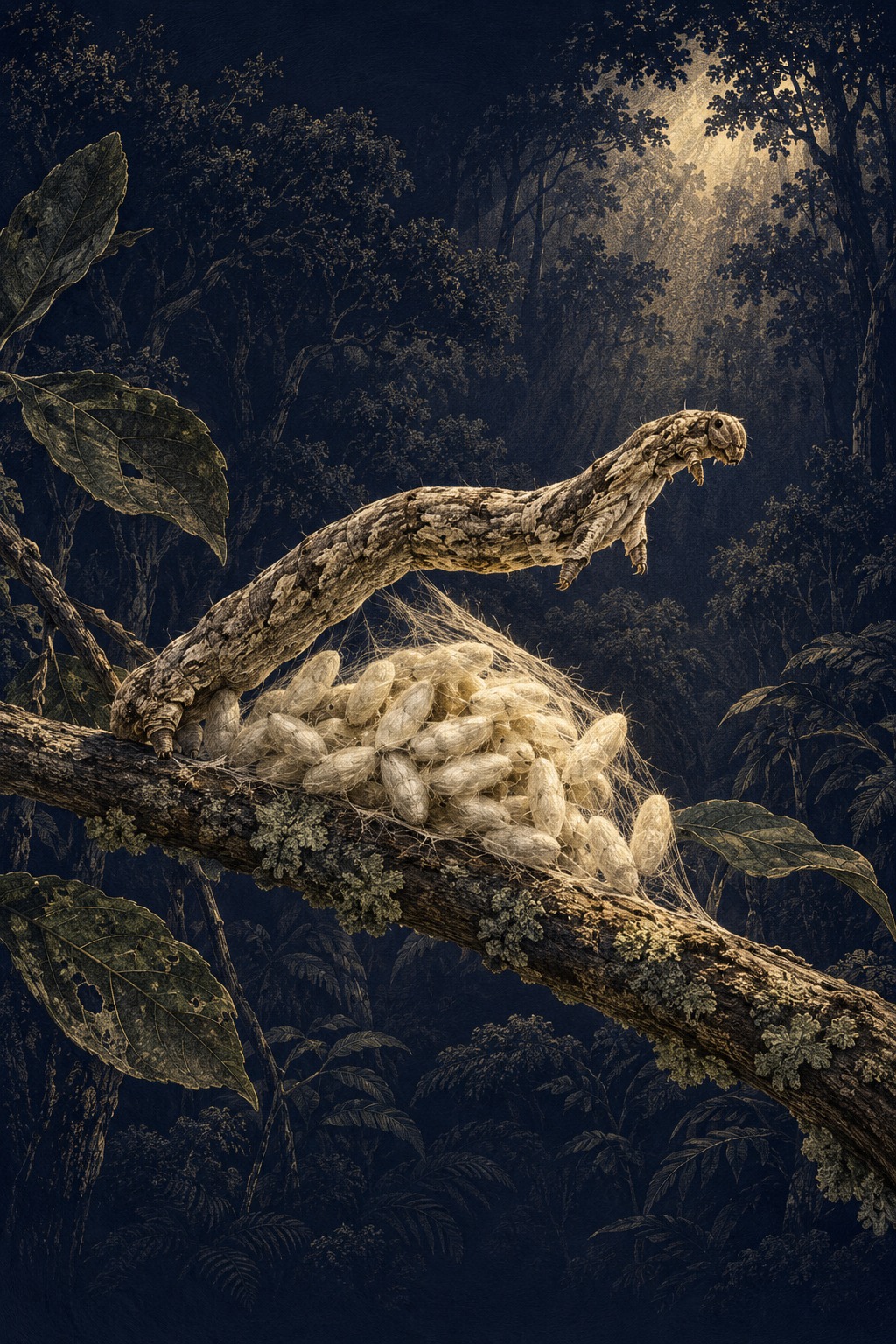
Glyptapanteles sp., an undescribed braconid wasp, and its host, the caterpillar of the moth Thyrinteina leucocerae
Strengths: perseverance, grit, courage, endurance, constancy, patience, resolve, self-mastery
Risks: martyrdom, servility, stubbornness, self-neglect, exhaustion, misplaced loyalty
Fortitude is grit and can only be measured in terms of your own abilities. Unlike raw talent, which can be measured in relation to other people, your ability to persevere through difficult situations can only be measured in relation to your "ideal" performance. Whether it's to lift a heavy rock or to read a heavy book, only you can choose to pursue and complete the task. Of course, some tasks are impossible for you while being quite easy for others, but that is a measure of relative strength, while fortitude is a measure of your intrinsic strength. So what are the most challenging aspects of your life this minute? What might you do to bolster your perseverance in your present goals? Not who might help you, but what can you do to raise your internal strength? What are the pressure points? Identify them and focus on them. Whatever the hardest part of your journey may be, focus on it and don't give up.
Motto: Strength is fortitude and fortitude is grit.
In most decks Strength is a woman closing a lion's jaws with her bare hands, gently, as if she were shutting a book. The point is that real strength is quiet and doesn't need to win the fight. This deck keeps the gentleness and swaps the lion for a caterpillar, which makes the question harder. Gentle on whose behalf?
In Brazil, a small wasp lays her eggs inside a young caterpillar. The larvae grow up in its body, as many as eighty of them, then chew their way out together and spin their cocoons on the twig beside it. Most parasitoid stories end there, with an empty host. This one doesn't. The caterpillar lives. It stops eating. It arches over the little heap of cocoons, and when anything comes near, it swings its head at the intruder like a club. In the field, this guarding cut the death rate of the wasp pupae in half. Then, its watch over, the caterpillar dies without ever becoming a moth. One or two larvae stay behind inside it, and the researchers suspect they are the ones doing the steering, though no one has proved it.
The Catechism of the Catholic Church says that fortitude "disposes one even to renounce and sacrifice his life in defense of a just cause" (para. 1808). By that standard the bravest creature in this deck is a caterpillar defending the children who ate it. It conquers fear. It faces trials. It gives its life. The only thing missing is the just cause, and the Catechism, to be fair, never says whose.
Darwin had grit to spare. He sat on his theory for twenty years and spent eight of them dissecting barnacles. Wasps like this one strained his faith. "I cannot persuade myself," he wrote to the botanist Asa Gray in 1860, "that a beneficent & omnipotent God would have designedly created the Ichneumonidæ with the express intention of their feeding within the living bodies of caterpillars, or that a cat should play with mice." Darwin never heard about the bodyguard. It would not have helped. Remember the cat, though. It comes back at the end of the deck.
There is no card for talent, because talent is handed out unevenly. Fortitude is a cardinal virtue because everyone has some and anyone can have more. Nobody is ever as strong as they could be. The caterpillar adds the dark corollary: make sure the ideal you're measuring yourself against is yours. Grit is the most easily exploited virtue there is. Every pyramid, every unpaid internship, every family that runs on one person's endurance has a caterpillar standing guard somewhere in it.
There's a coda. When researchers looked at the same caterpillars on plantations of introduced eucalyptus, the guarding did the wasps no good at all. The same courage in the wrong forest is a caterpillar swinging its head at nothing.
Leibniz's strength was that he could work in every direction at once. He brought so many things together that he gave us the calculus and a mathematical logic. That is fortitude freely chosen, and it is the opposite of the caterpillar. So when this card turns up, ask the old question first: what can you do to raise your internal strength? Then ask the caterpillar's: whose cocoons am I guarding, and would I still guard them if I could see what was inside?