The Pretty Parasites Tarot guide
IX · The Hermit
Orange Lantern in Litter
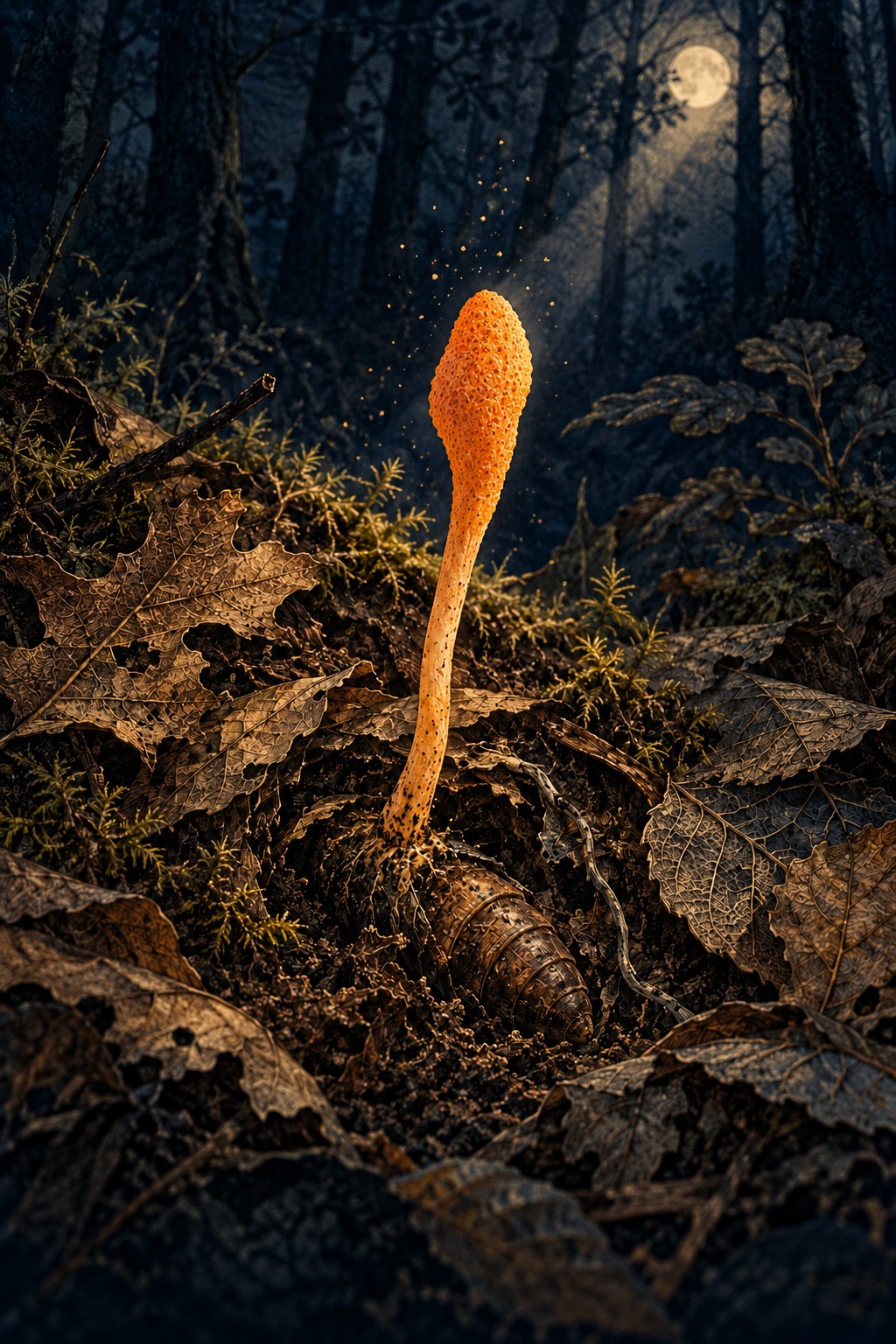
Cordyceps militaris, a fungus that grows from buried moth pupae
Strengths: concentration, introspection, meditation, solitude, stillness, study, tranquility, pilgrimage, tenacity, intuition, wisdom, research, discovery, comprehension
Risks: conceit, isolation, loneliness, suspicion, resentment, condemnation, fatalism, obsession, persecution mania, illusion, self-centeredness, misanthropy, vanity, poverty, indifference
The Hermit is meditation and clairvoyance. But why are they alone? Have they been ostracized by society, or was there some crisis that made them abandon the world? The inner light of her intuition lets her see much that is hidden from others. If she is wise, her understanding of herself gives her great insight into the psychology of others. But she may also be conceited, projecting her ideas onto the world without seeing them from other perspectives. If you find yourself on this journey, consider what you're sacrificing, not only socially or materially but psychologically. Is it time to look beyond yourself, or is your solitude a productive and joyous one? Remember that introversion is not necessarily wisdom. Is your inner life guiding you toward truth and beauty, or are you wandering alone in a dark and barren wood? If the Hermit is someone else, be patient and you may intuit remarkable wisdom. They may also just be a self-important jerk, in which case, good riddance.
Motto: Beauty is truth, truth beauty, and that is all you need to know.
Where the Fool represents the inquirer, the Hermit represents the reader. Both are travelers, but the Hermit's lantern lets him see in the dark. Like the Magician, the Hermit relies on his own nature and intuition. Like Justice, he has a deep understanding of right and wrong, which doesn't mean he has chosen a side. The Hermit is a figure on the threshold, more likely to watch than to take part, and that gives him the rare insight that comes from seeing from several places at once. Of all the figures in the Tarot, he is the closest to a prophet.
In the Marseille deck the Hermit stands for the journey into the unknown and the highest form of wisdom, but that wisdom is the product of crisis: the clairvoyance that comes from trauma, loss, and rejection. Exile is an old punishment, and the Hermit may not have chosen his solitude or the wisdom that came with it. The isolation is spiritual, and a king could reach it as easily as a monk, or a K-pop singer, or an entire K-pop group.
The lantern comes from Diogenes the Cynic, who walked through the Athenian marketplace in broad daylight carrying a lamp. Asked what he was doing, he said he was looking for a man. Later retellings made it "an honest man," but the ancient sources just say "a man," which is worse. He slept in a big clay jar, threw away his only cup after watching a boy drink from his hands, and, when Plato defined man as a featherless biped, brought a plucked chicken to the Academy. Almost everything we know about him comes from Diogenes Laërtius, writing more than five centuries later, so think of him as a lamp more than a man.
This deck's Hermit lives in the leaf litter. A caterpillar that has finished eating goes down into the soil or under the dead leaves to pupate. It is the most hermitlike thing an animal can do: leave the world, seal yourself in, dissolve, and come back as something else. Cordyceps militaris is waiting in the dark. Its threads fill the pupa and eat it from the inside, and what comes up out of the litter is not a moth but a small orange club, a lantern lit by the body it consumed. The spores drift out from its tip.
That's the Hermit's riddle. The caterpillar went into solitude to be transformed, and it was. Diogenes went looking for a man with a lamp; this lamp went looking for a moth, and found one. Franky's 2022 notes say the Hermit's wisdom is born of crisis and exile. The fungus agrees, and adds a footnote: the wisdom doesn't always belong to whoever went through the crisis.
In the Rider-Waite deck the Hermit's lantern holds a six-pointed star. The Gnostics taught that each of us carries a spark of the true light trapped in matter, and that the point of withdrawing from the world was to find it. C. militaris teaches the same doctrine with a straight face and one correction: the matter is the lamp, and the spark is somebody else.
Hermits have always attracted pilgrims. The compound cordycepin was first isolated from this fungus in 1950, and today C. militaris is grown commercially on grain and sold as dried orange stalks for soup and tea. The lantern no longer needs a moth. It has customers.
Franky's other great hermit is Tiresias. In one version of the myth he struck two mating snakes with his stick and was turned into a woman for seven years. Later, when Zeus and Hera argued over who enjoys sex more, they asked the only person who had tried both. Tiresias said women did, nine parts out of ten. Hera blinded him for it, and Zeus, unable to undo it, gave him second sight. Wisdom, again, as compensation for a wound. Satoshi Nakamoto belongs on the list too. He lit something, walked back into the dark, and hasn't been heard from since.
If you draw the Hermit in a time of crisis, consider what it can teach you. Necessity is the mother of invention, and loss, rejection, even death can be the mother of perspicacity. If you draw it in a time of peace, ask what you've withdrawn from, and whether anything followed you into the dark. Being alone isn't the same as being wise. Sometimes it's just being alone with a fungus.