The Pretty Parasites Tarot guide
Nine of Pentacles
Black Boot Cords
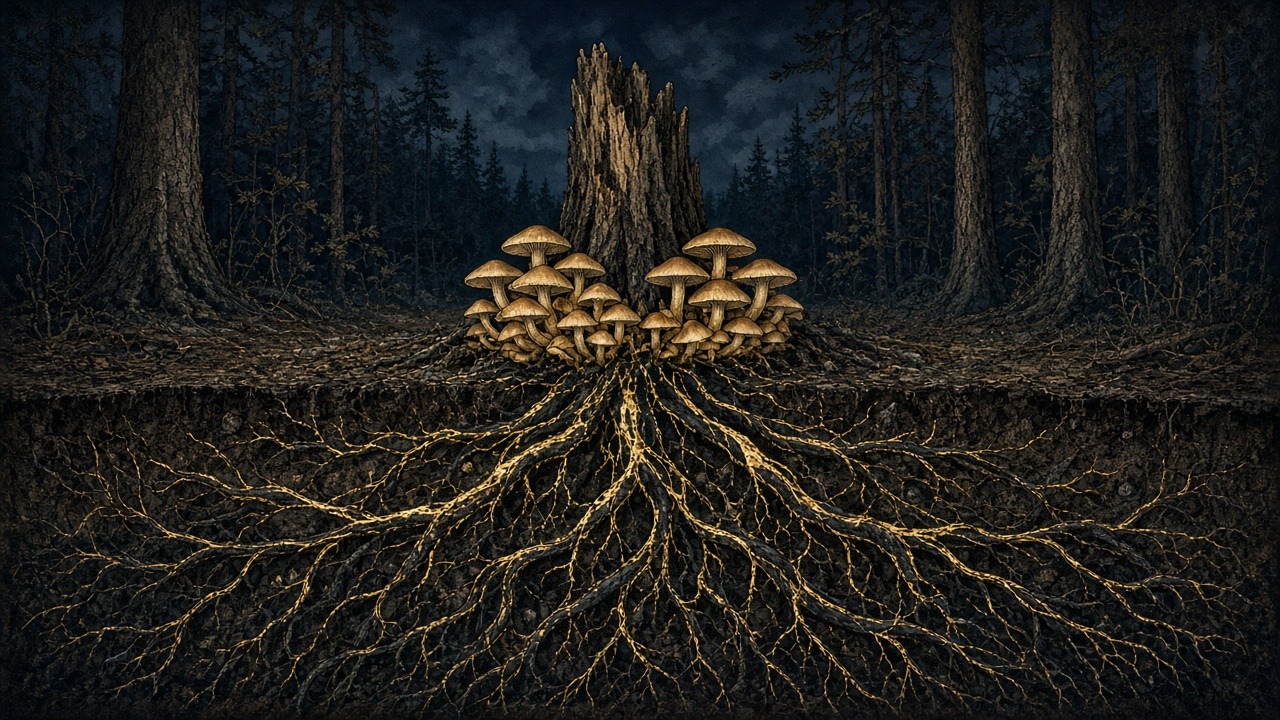
Armillaria ostoyae, a honey fungus and root pathogen, the "humongous fungus" of Oregon's Blue Mountains
The Nine of Pentacles is a woman alone in a vineyard, in a long robe patterned with flowers, a hooded falcon on her gloved hand. Nine coins are stacked among the vines. She built all of this herself. It's the card of self-sufficiency, earned comfort, and the solitary luxury of needing no one. Take a good look at the garden. In this deck, the garden is her.
In the Malheur National Forest in eastern Oregon, a single individual of Armillaria ostoyae, one genetic organism, has been mapped across about 965 hectares, nearly four square miles. Estimates of its age run from under two thousand to more than eight thousand years. It's one of the largest living things ever measured. Most of it is invisible. It spreads underground through rhizomorphs, which are black, root-like cords (foresters call them "bootlaces") that grow through the soil from one tree to the next. The cords get into the roots, the fungus spreads under the bark as white fans, and the tree slowly dies. Not every honey fungus is this deadly, but this one can kill tree after tree across a whole mountainside, and it doesn't stop eating when they fall: it lives on in their dead wood. In autumn, it sends up clumps of honey-colored mushrooms at the base of the trunks, a small sign above ground of an enormous estate below. Some Armillaria can even make decaying wood glow faintly in the dark. That's the old "foxfire" of woodland stories.
This is the card of the load that looks like freedom. The opportunity of the Nine is real independence. You can build something vast and lasting that runs on its own. The humongous fungus has spent millennia doing just that. The risk is the price. The garden grows because the forest pays for it, tree by tree. Wealth that looks self-made is usually financed by someone. Ask whose roots your estate is running through, and how many dead trees it takes to keep the vineyard green.
Scene: a woman in a robe of honey-colored mushroom caps stands in an autumn forest. The falcon on her hand is hooded. Under the thin soil at her feet, drawn as if in cross-section, nine black cords spread out to the roots of the surrounding firs, and the farthest trees are already bare.
Prompt: Write down one thing you've built that you're proud of doing "on your own." Then list everyone and everything that quietly paid for it.