The Pretty Parasites Tarot guide
Page of Pentacles
Green Scout in the Litter Bank
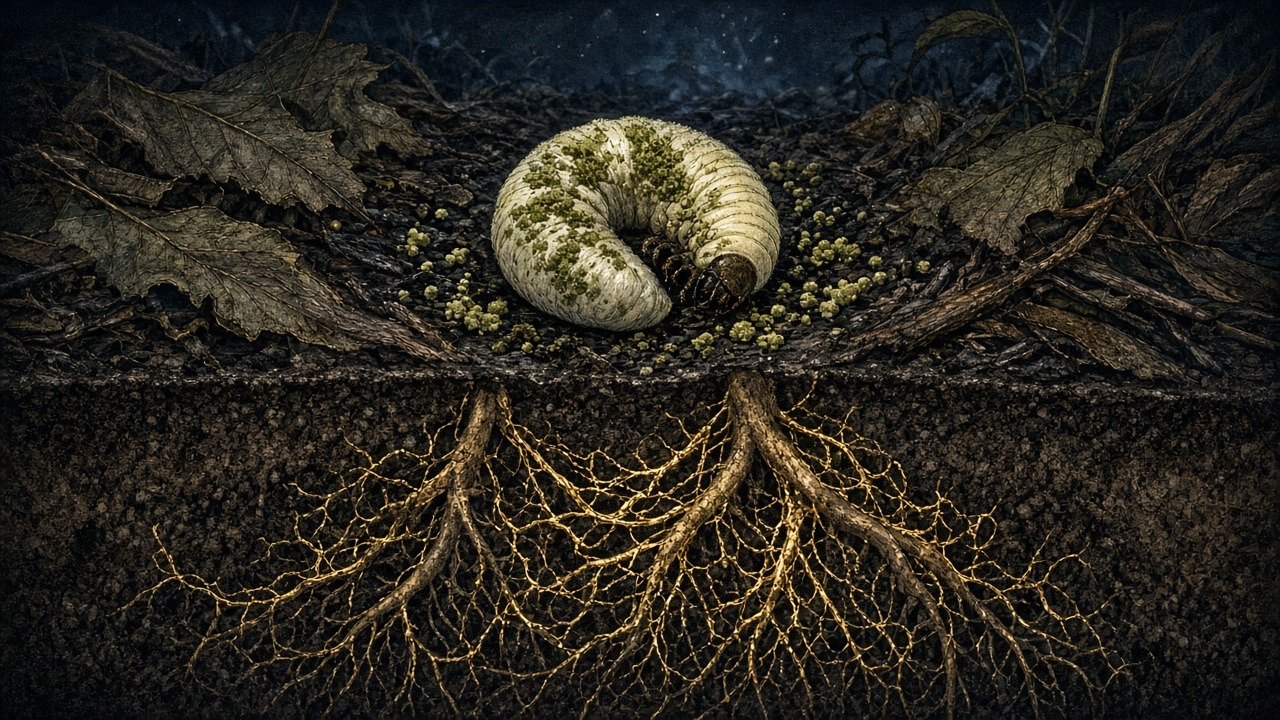
Metarhizium anisopliae (in the broad sense), the green muscardine fungus
When you meet a friend who is probably yourself from the future, it's the Page of Pentacles (PP). So old PP there is gonna talk to you about love and forgiveness. This is a lie. Forgive no one. Why? Because no person can ever forget. Forgiveness requires forgetfulness and you don't wanna be forgotten. Right?
— Franky Forlorn
The standard Page of Pentacles is a young man standing in a green field, holding a coin up in front of his face and staring at it as if it might talk. He's a student, a beginner, a messenger of practical news. He's also suspiciously patient for someone his age. Franky thinks he's you, from the future, lying about forgiveness. The fungus agrees about the memory part.
Metarhizium is the white Beauveria's green cousin. It's a close relation in the same fungal order and in the same line of work. It lives in soil, especially around plant roots, and its spores wait there for an insect. When one comes by, the fungus goes through its skin, grows inside it, kills it, and then covers the body in a crust of olive-green spores. In the late 1870s, the Russian zoologist Ilya Metchnikoff (who later won a Nobel Prize for discovering how white blood cells eat invaders) grew it and proposed using it against a beetle pest of grain. It was one of the first serious ideas for using a fungus as a pesticide. Its relatives are still sold for that purpose today.
The part that makes it Franky's Page is what happens next. Metarhizium also lives on and inside the roots of plants. In a 2012 experiment, researchers let it kill insect larvae in soil with bean and grass plants growing nearby. They tracked nitrogen from the dead insects and found it had turned up in the plants, carried there by the fungus, which was getting sugar from the roots in exchange. The soil doesn't forgive. It doesn't forget. It files every dead beetle as income and moves the balance to someone else's account.
So when the Page shows up, pay attention to small messages about money, work, study, and the body, and to the long memory of the ground you're standing on. The opportunity is apprenticeship. The Page is patient and curious and learns by staying close to the roots. The risk is the one Franky names. Some of the advice you'll get about letting go comes from people who have never had to let anything go. And some of what you won't forgive is quietly feeding something else.
Scene: a young gardener kneeling in leaf litter at dawn, holding up a green-dusted beetle between finger and thumb like a coin. Beneath the soil, drawn as a cross-section, fine threads run from the beetle's body into the roots of a bean plant, which is flowering.
Prompt: Write a letter from yourself ten years from now. Have your future self tell you one thing you should never forgive, and one thing you should never forget. Are they the same thing?