The Pretty Parasites Tarot guide
Knight of Swords
Lance Through Oak
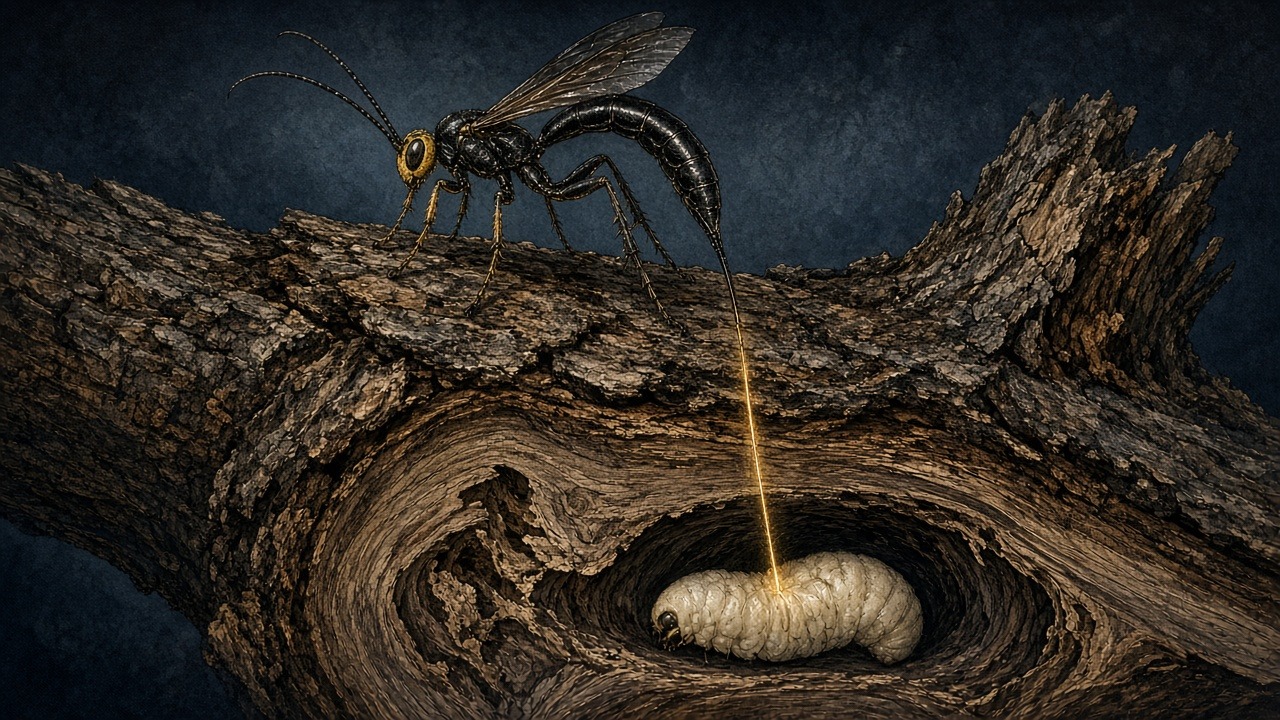
Megarhyssa atrata, the black giant ichneumon wasp
The Knight of Swords charges full tilt into a storm, sword raised, on a galloping horse, while the trees bend and the clouds tear. He's the most headlong figure in the deck: brilliant, brave, and in too much of a hurry.
Megarhyssa atrata is described as the largest parasitoid wasp known. A female's body can be an inch and a half long, and the stylus of her ovipositor has been measured at 142 millimeters, the longest genitalia known in any arthropod. She uses it to reach the larvae of the pigeon horntail, a wood wasp that bores into dying or recently dead hardwoods. The horntail mother injects a wood-rotting fungus along with her eggs, and her larvae need it to grow in the wood. Somewhere deep inside a dying oak, or maple, or beech, a horntail larva is chewing. The giant ichneumon finds it from outside.
What looks like one long tail is three filaments. The two outer ones are sheaths that bow out during egg laying. The central shaft does the drilling, and it's two interlocking halves that slide against each other, with the egg passing down a channel inside. Its tip has pores that release secretions which may lubricate the way, and along its length run six rows of tiny touch sensors. For all that, it can't sting a person. The lance has one purpose.
Here's the riddle. The Knight looks like the fastest card in the deck, but the real lance here is a slow one. The wasp doesn't charge. She stands still on a dying tree, feels her way into the dark through solid wood, and finds a single hidden larva without ever seeing it.
When the Knight appears, you have momentum and a sharp point. Use them. But the most impressive charge in this suit is the one made standing perfectly still. Before you ride into the storm, feel the wood.
Scene: a storm-bent forest; a black wasp with yellow-banded legs standing motionless on the trunk of a dying oak, her impossibly long ovipositor arched like a knight's lance into the bark; inside, shown in cross-section, a horntail larva curled in its tunnel; behind her, wind-torn clouds shaped like a galloping horse.
Prompt: Write about a time you rushed in. Then write what you might have found if you had stood still and felt your way first.