The Pretty Parasites Tarot guide
Queen of Swords
Darwin's Glass Court
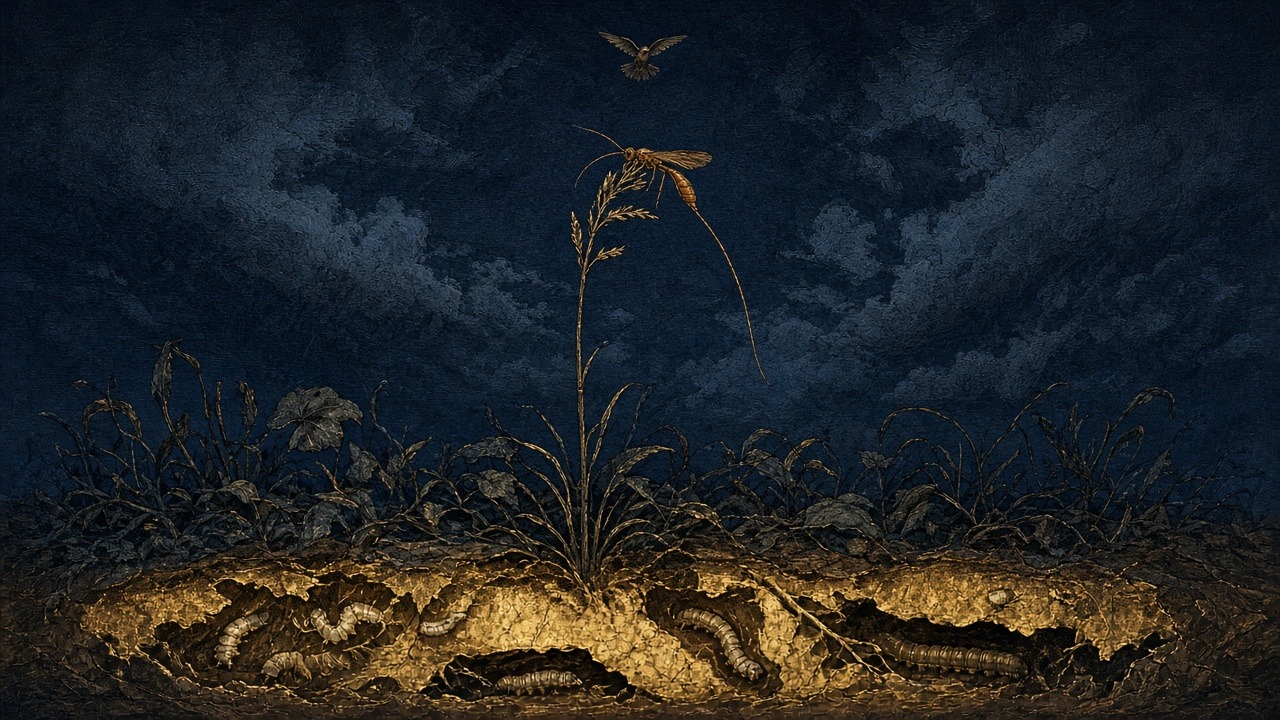
Ichneumonidae, the Darwin wasps
The Queen of Swords sits crowned on a throne in the clouds, one hand raised, her sword held upright, her face in profile and unsmiling. A single bird flies high above her. She's the clearest mind in the deck: perceptive, honest, unfooled. Waite's old meanings for her are surprisingly dark, too: widowhood, mourning, absence, separation. She sees clearly because she has lost something.
Ichneumon wasps helped convince Charles Darwin that not everything in nature could be the work of a kindly God. They are the wasps in his 1860 letter to Asa Gray, the one quoted under Fortitude. In 2019, ichneumonid specialists from fourteen countries proposed that the family be called "Darwin wasps," for the part they played in that doubt.
The Queen's court is mostly uncounted. About 25,000 species have been described, and that's probably less than a quarter of the real number. The family may hold more species than all the vertebrates on Earth combined. For years people believed these wasps broke the usual rule that life is richer in the tropics, until researchers sampled a few tropical forests properly and found 177 likely new species in a single subfamily, more than three times as many as that subfamily was known to have in all the world's tropics.
Here's the riddle. The Queen's court is made of glass because you can see straight through it and still not count it. Most of her subjects have never been named. And the bird above her is the one creature on the card that's free. The Queen of Swords is widowed in Waite, and Darwin wrote that letter nine years after his daughter Annie died at ten. "We have lost the joy of the Household," he wrote a week after her death. Historians still argue over what it did to his faith; no one argues over what it did to him. The clearest sight in the deck comes from grief.
When the Queen appears, you may be seeing more clearly than you want to. Honor it. Clear sight after loss isn't coldness. It's the mind refusing to lie about what happened, and that refusal is a kind of love.
Scene: a queen on a throne of clear glass set in the clouds, one hand raised, a slender wasp-waisted sword upright in the other; inside the glass of the throne, thousands of tiny wasps like trapped stars, most of them unnamed; one small bird high above.
Prompt: Write about something you understood only after a loss. What did grief let you see?