The Pretty Parasites Tarot guide
Ten of Swords
Sapphire Drag
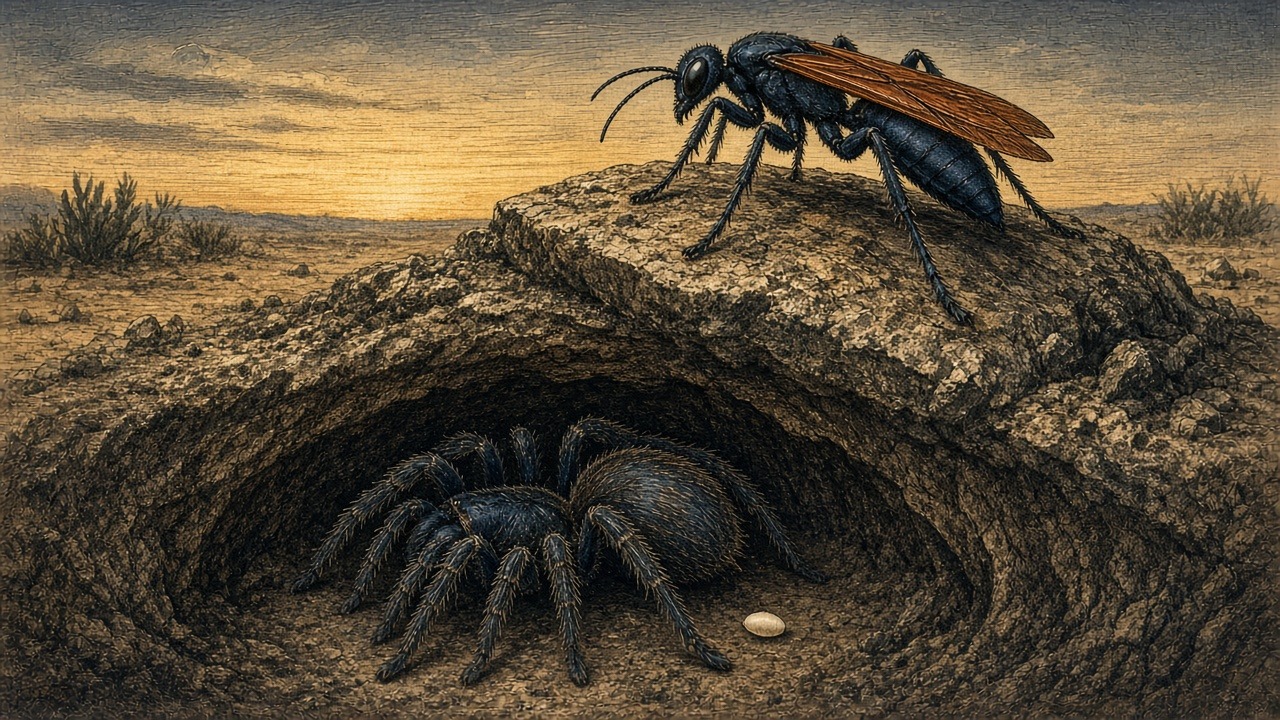
Pepsis thisbe, a tarantula hawk of the Texas desert
The Ten of Swords is the most theatrical card in the deck. A man lies face down on the shore with ten swords in his back, under a black sky. But along the horizon, the sky is turning yellow. It's rock bottom, the painful end, the worst-case scenario, and the dawn that comes anyway.
The tarantula hawk is a spider wasp built for spectacle. A female Pepsis thisbe in Big Bend, Texas, can be nearly four centimeters long, with a body of midnight blue and wings of rusty orange. She hunts one kind of tarantula. She stings it, paralyzes it, drags the huge spider backward to a burrow, and lays a single egg on its abdomen. The spider almost never wins. In more than four hundred observed fights, a tarantula killed the wasp only once. The larva grows through five stages, eating the spider's less important tissues first and saving the heart and nerves for last. A wasp that grows up on a bigger spider becomes a bigger wasp. And the sting is one of the most painful known to people, yet it's of very low danger. It hurts enormously and almost never does lasting harm.
Here's the riddle. The Ten is the card of overkill: ten swords when one would do. The tarantula hawk is overkill, too, the most painful sting for one of the least dangerous. The card's secret is in its horizon. Pain is not the same as danger, and the worst moment is often the end of the worst part.
When the Ten appears, it's allowed to hurt. Something is over. But look up at the yellow line along the edge of the sky. The card has already been painted with the next morning in it.
Scene: a desert at dawn; a huge tarantula lying on its back, ten thin sapphire-blue swords standing in the sand around it; a midnight-blue wasp with orange wings pulling it backward toward a burrow; a gold line of sunrise along the horizon.
Prompt: Write about the worst day you've survived. What was the first sign that it was ending?