The Pretty Parasites Tarot guide
Ace of Wands
Strigolactone Spark
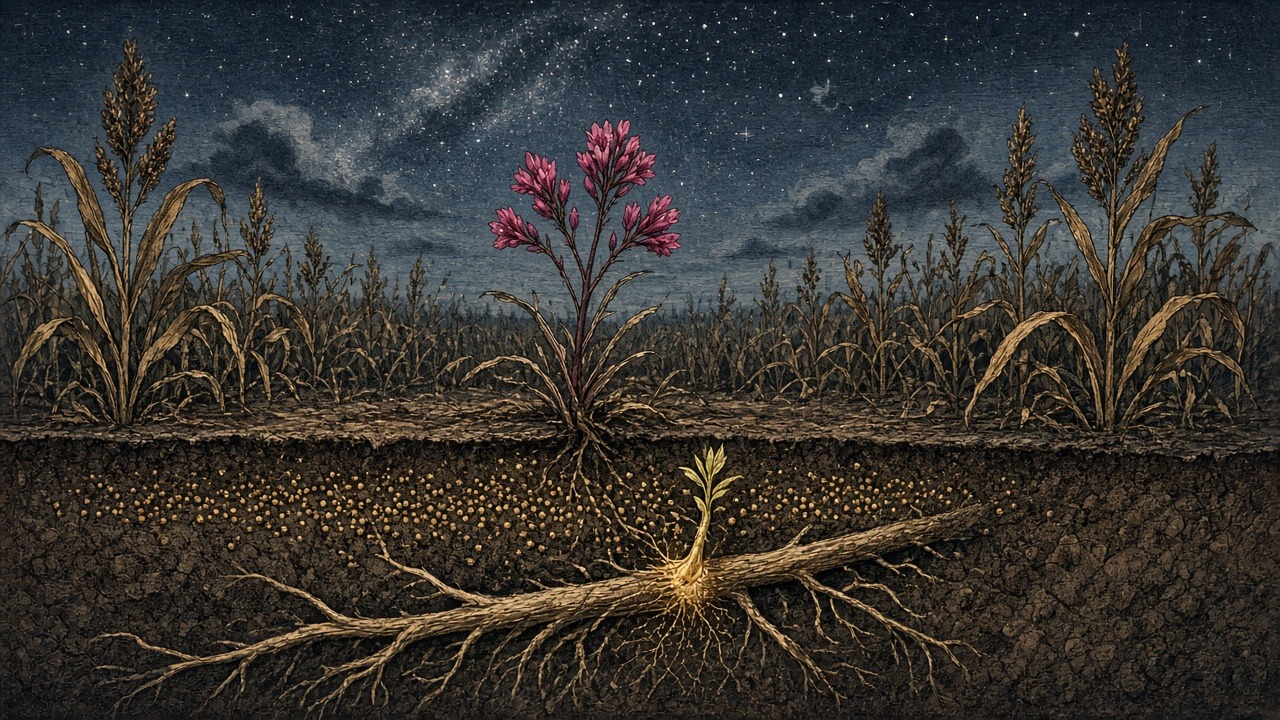
Striga hermonthica (witchweed; Orobanchaceae), an obligate root hemiparasite
A dust-fine witchweed seed can wait in the soil for years and will not germinate for moisture, warmth, or prayer — only for strigolactones, hormone signals exuded by a host's roots. On that chemical whisper it wakes, drills a haustorium into the stranger's root, and taps the xylem for water and minerals while keeping its own modest green. It is a serious pest of African cereal crops, but here we are reading its ambition, not its rap sheet.
Everything the earlier version of this guide said about the Ace's energy still stands, because Striga is that energy given a root system. This is a high-energy card: you are obsessed with obtaining as much energy as possible, whether calories for your body or Gcals for your civilization. Life is better at playing the game of energy capture than rocks are, but the game is played in a frigid casino and the house always wins — and yet everything from plucky amoeba to Ediacaran shrimp has had the nerve to sit down at the table. Life is shamelessly optimistic. The witchweed seed is the optimist's optimist: it bets its entire inheritance that someone nearby is about to exhale.
And you are the worst offender, since not only are you full of delusions of grandeur and illusions of universal love, but every eukaryote, bacterium, and protozoan in your body is also playing its own game — billions of lives hustling the mean streets of your veins and capillaries, patrolled by the brutal lymphocytes, who are the real killers. Your body is a chaotic, some would say unhinged republic. The Ace of Wands is the most elemental expression of pure heat in the deck, more than the Star or the Sun — but remember what heat does at scale. In places with far more energy than our drab corner of the universe, in crowded galaxy clusters like Virgo, hot gas strips galaxies of the cold gas they need to make new stars. Energy is violence.
So: high energy does not mean new growth. The seed that wakes at the wrong chemical signal, or beside a root that cannot feed it, has spent everything on one ignition. The opportunity is ignition itself — the rare chemistry that turns years of dormancy into motion in a single night. The risk is the same event read from the other side: the thrill of the signal overriding the question of whether the host can carry you. The more thrilled you are, the more cautious you should be about all the self-interested parties of your body and mind telling you to go boldly where no hominid has gone before. The avant-garde is always the first to die.
Scene: a black furrow of savanna soil, one violet spark breaking the surface among millet stems, the underground handshake between root and haustorium drawn as a struck match.
Prompt: Write about the last time you germinated on someone else's signal. Whose chemistry woke you, and could they afford it?